Wednesday, 27 March 2013

How to Make 50Kg Float?


So I made a promise about blogging at least once a week and I’m going to try and keep it; I was worried I wasn’t going to be able to write very much this week. It’s been a very busy week and I haven’t done very much making but, I have been doing a lot of prep for projects that are coming up. I have also had formative assessments and production plan to hand in.

How do you make 50 kg float? This has been the big question of my week and as a result I have been crunching a lot of numbers. I have also been collecting quotes for stock, contracted work and commissions as a result have spoken to a lot of people. This has all been part of my Fresh Air project and I have been working on how I’m going to construct my Piece and there is so much to take into account. The finish Object is becoming quite the beast and is going to weigh somewhere in the region of 200 kg. Some of the stock sizes that I will be using is 50 square and as a result both cost wise and environmentally I have been looking for alternative suppliers (Scrap Metal and Reclamation). Other alternatives are very hit and miss as a result might not provide me with the best results.

One of the main qualities of my piece is the form and this will affect the overall feel of the work. Although there are only four major components in the sculpture each component must accurately and efficiently reflect certain ideas. Therefore the way I choose to construct components directly influences the overall feel of the finished object. Clean, crisp and accurate forms will allow me to create structure that looks elegant and strong but without compromise. So for the main body of the sculpture I have been looking at a third party creating this component. SWS (special welding services) has a 350 ton press brake, which I’m hoping that they will be able to fold an accurate and sleek arc out of 20 mm thick plates.
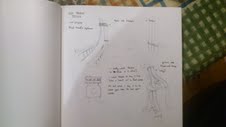
I have also been talking to some glassblowers about creating a vessel to float one end of the arm on my sculpture. Mathematically and visually this is proving very difficult; I want my work to look elegant and give a certain feel but at the same time I don’t want it to look like a toilet cistern. If the arm is able to float then it will interact with the water much more intuitively and give me the desired qualities that I’m looking for.

We also had to produce a small statement, visual representation and name for our work for the fresh air catalogue. This is all new to me and will be my first public display of my work. It’s quite exciting and interesting to be going through this process I must admit for the most part I’m not enjoying it but the overall experience from start to finish should be good. All educational side also working a lot larger than the normally would and I think this feels quite daunting. There is also a cultural exercise within this project to see how people take to my work. What they think as visually and conceptually.

Wednesday, 20 March 2013

Fresh From the Box

So this will be my first blog post using Dragon naturally speaking. I’m making a conscious effort not to use any typing if possible and to be honest it’s a little weird; but it works really well. So I’m not going to edit this at all. I have also got loads of new equipment like a drawing boards and I started using my scanner printer. So as a direct result I might be churning out more crap and waffling lots so here goes the post. Now my new laptop and software is here I should be able to post blog much easier as i made a statement earlier on in the year that I would be making a blog post every week. That hasn’t been the case and I also feel I should be talking more about myself and my work. So that will also be a change like as had previously I have some new equipment like a drawing board that was given to me with the parallel arms broken; and now that its fixed its really cool. I also got a lamp as a present which was also broken which is also fixed now. I have my laptop with all the cool gear and software so should be even easier to get some cool stuff done this year.

My new workspace


So a lot of my time this new semester has been taken up by a project called fresh air. Fresh air is a biannual sculpture exhibition that raises money for the fresh air trust. The opportunity that I have been offered is incredible, they want me and my class mates to fill a number of exhibition spaces that will have some where in the region of 16,000 people see them. I personally think this is an incredible opportunity and something that I have pressurised myself unnecessarily about. Saying that, I have got a place and the added pressure I guess has helped and hopefully I can create something really nice that will get me noticed.

Design border model


Fresh air takes place on the 23rd June in a small village called Quenington, in Cirencester. As students at Hereford College of Art we were asked to produce work that responded to the site. The piece that we create has to be based in our chosen profession and reflect ourselves and our concepts as designer makers; so I have chosen to create a piece that reflects the beauty of nature and innovation of the human mind. Hopefully my piece will show the unique balance that planet Earth is in. I’m hoping to create a piece that directly reflects the way I see the world around me, I have picked very direct visual influences that I will used to inform my ideas. These are based on seeing limbs of trees hanging into the waters that run to turn a once working water Wheel; I want my piece to directly reflect both of these visual experiences. So I hope that I will be able to produce a sculpture that looks both mechanical and organic and interacts with the water in the same way as the trees and the water wheel.

Scale model


So if you want to find out more about fresh air they have a website http://www.freshair2013.com/ and a Facebook page http://www.facebook.com/pages/FRESH-AIR-Quenington-2013/220719344729151?fref=ts so go along and check out.

So this is a request to my readers. I do not know who you are, but I would like to. I get a lot of information on blogger about the people who view my posts, and a lot of these are quite random hits and as a result I’d like to know what you guys want to know about me and what I’m doing because that’s why you’re reading I think and I hope. So let me know what you like, what you don’t like and what you would like more of and questions if you have them because I’m sure there must be people out there with questions about all sides of forging and blacksmithing.

Some of my stuff


Dragon Naturally Speaking is amazing and has made writing this post really easy hence why I have waffled so much, if you like to know more about Dragon naturally speaking leave a message and I’ll try and get some information for you.

Thank you monkey “Cuppa Tea?” Love it. xx

Sunday, 10 March 2013

What would Brunel do?


The other day my Learning support equipment turned up and It couldn’t have arrived sooner. I have been dyeing to get my hands on a laptop, not just for the massive aid it will give me in my written work but how I will now be able to get hold of Autodesk CAD. In the last year or so I have been playing round with the idea behind forging and modern technologies and how they work together. I made so real progress in my last semester and I hope to carry on, but in recent months I have been show all sorts of new and amazing techs that are available to me. So I’m brought on to this next question “Would Isambard Kingdom Brunel use modern tech to make his creations??? This is as simple as welding gear, angle grinders and electricity?” And I was just in a lecture with Michael Eden talking about using 3D printing and the options that that can provide.

So As a directed result I have found myself asking people to create my ideas in a programme that allows a machine make them. As a directed result I was moving away from the making of my piece. So now I have Autodesk and I’m one step closer again which is great but this itself has a side effect. I’m now adding more layers of design to an already complex and long winded process. I feel that the hand drawing still is important as it allows me a level of freedom but with the study of CAD I can send information to machines all over the world and as a directed result I have l ready thought about using 3D printing and talked to a engineering company that uses CNC lathes so that I can use CAD to its full.

CAD is full of potential and with proper study that leads to well thought out ideas I should be able to make some amazing stuff. This also apply to the forging, 3D printing and other CNC process with balance I should be able to create beautiful and interesting things. If you’re a student or a teacher Autodesk is available for free from http://students.autodesk.com/ You Just need to register and they will send you a copy and they also have many other types of software that might help you change the way you see design also. O CAD is well worth a look and is going to open lots of doors for me from basic design work at college and I hope in the future with customers and other skilled people.

So from the modern to the crazy hears me and some of my class mate forging a big ring old school style. Tell me what you think about any of the items in this blog post and the silly video. Thanks

Friday, 28 December 2012

A Trip to Valhalla and Thors Workshop

I have recently returned from an amazing trip to Sweden where I not only have I realised that I'm not alone in my ideas about what forging is but what I can take from forging. Its not just about an aesthetic it can be all about the process and that process can allow me as an artist and an engineer some truly amazing things. I truly believe that forging has something to offer me and my creative process. I’m not saying I'm a blacksmith and I don't really want to but I'm really starting to value the process. when done right its fast, impressive and rewarding but really difficult.


There where two reasons for my trip to Sweden one was to visit a college called Steneby and the other was to meet a blacksmith or industrial free forger called Roger Lund. Both of witch have inspired me and I’m going to try really hard to uses forging not only to inform my work but to raise awareness for the trade; And I really think this is possible. Roger and Stenby are both very modern working environment not only in work practice but in ideas. Its nice to know that we didn't fight two world wars and pull are stubborn top hat wearing arse out of the Victorian age for nothing. In fact it just seems that the only stubborn top hat ware fools also still think they haven't become part of the EU ether. (Sorry to all my silly leaf making, Vikings, shouty friends but that will be my last bad comment, Oh and that one as well.)


Steneby runs a number of craft based cause that run from foundation to MA. They have courses in textiles to iron and steel and boast a massive range of facilities to allow a global selections of students to really push both art and design. I was really impressed by the range and quality of work. The work isn't really based on and round process but more what can be done using said process's and with a course leader like Heiner Zimmermann that’s to be expected. The college has also been the play ground for the great Albert Paley where he worked for a week with students and gave lectures and made a selection of sculptures. I am very interested in there design MA which I hope to attend one day. This course would allow me to freely explore ideas that I have about metal work and my own conceptual ideas.


I also went to meet a man who can only be described as Thor an industrial free forger called Roger Lund. I drove half way across Sweden to meet a man that does one of the rarest jobs in Europe; in a little village out side of a town called Kristinehamn. Roger produces high spec components that are used in industrial application and in the auto motive industry. Using a range of power hammers and upsetting tools Roger produces every thing from pinions for Porsche to Drive shafts for high spec plant equipment. He has amazing skills and works at an amazing speed. His control and skill allows him to be quite the smith and his understanding of process means that he can create very complex and accurate shape in amazingly rapid time. Roger forges 45Kg pieces of stock into pieces that have to be in tolerance of 2mm using a 800kg hammer and lose swage tools. I got to have a play on some of his hammers and lets just say he make it look silly easy. What Roger does for a living is very attractive to me and I think what he dose as a smith is very exciting. I mean out side of the finished piece and concept I don’t find most parts of forging very interesting. Its frankly long winded and hard work. And other than some high spec strength application and mass forging offers very little.


Before every one goes nuts and tells me about all there favourite part of blacksmithing I am aware that it has a range of unique and interesting aesthetics. This means very little if it fits nether the concept or the completed piece. The process it self is often a selfish part of enjoying what you make. Its something that is often miss understood by the viewer and the maker. Just because you can isn’t really a reason more of a selfish out look and I believe as makers and artist we owe more to are work. Roger uses his process because it works and it is the best way not cause he enjoys it. In fact what Roger does isn’t rare, but just the way he does it is. America produce about 7billion dollars of forged items every year and Europe produces a similar amount. Its just done with machines and multiple step dies.


Thank you to Otto Stevensonn and every one at Steneby all very friendly and helpful.

Super special thanks to Roger Lund amazing guy and super cool.

And a very super big thanks to Monkey, couldn't have done it with out ya. xx Love you very much xx

Tuesday, 13 November 2012

Satisfactions through Work?


The idea that to satisfy the soul a person must work. They must create objects and change there surroundings. I must have an influence over the objects that I interacted with and this in turn creates emotional connection. There for products embody my emotion and provide satisfaction through work. This could be through farming the land to grow crops that I can eat or forging metal to make tools to cut my crops down. These are the ideas and thought of Karl Marx.


Karl Marx came up with the idea of socialism the idea that through self motivated and emotive work that we could work together to create communities that flourish and produce diversity individual who are happy and satisfied. This idea comes from the belief that work is not an instinctual raw animal thing but it is considered and well understood. So when people are forced to work with out there own emotional content or thought they loose this sense of satisfaction. They become disheartened and seek destruction in other whys like possession, entrainment and others.


But this sale of labour for moneys creates problems for the crafts person creator because if they are to survive they must sell there products. Does this idea of creating to survive in a capitalist community still allow use as individuals to be satisfied. And this is where I'm at I believe that as a skilled person I cannot be satisfied by just money. I need more, I need to be able to create and produce products that contain my emotions and self. Can I achieve this in my work and newly sort after practice???

The writer must earn money in order to be able to live and to writer but he must by no means live and write for the purpose of making money.

Karl Marx 1848


Thursday, 8 November 2012

It’s all in my head it’s just how to get it out.


It seems to be all about tutorials this year and my last tutorial with Del and James Has started the ball rolling again. I have produced quite a bit of work so far this year and everything seems to be going well but I’m having real trouble with coherency. I have made Maquette’s produced drawings both sketches and technical which I have made into CAD files and then laser cut and water cut. So I feel that all is well but something isn’t working. Not only do I use a lot of stored data from my apprentership and working career but I have real trouble showing people the path from idea to finished piece.


One of the main reasons for this lack of coherency is my complete disorganisation. I need to collect my work together in one media that show my work in order and with clarity. So I hope to do this by editing the way I use my sketch books. I have been thinking about this a lot and I need to do this constructively. So I have come to the conclusions that I’m going to do away with my sketch book and just work on sheets of A3 paper of all sorts of type. Tracing paper, Graph paper, Carbon paper and cartridge paper.


I hope to use these different types of paper to allow me to add some coherency to my work along with high quality A3 print outs that use text and primary and secondary images. And place them in order, using some type of binding. I don’t have a problem with using different sketch books but I do seem to get carried away with ideas. I also need to find away to get my technical data across. I was thinking about creating stories about the piece I make like schematics or documentation that cover concept and theory. It’s all in my head it’s just how to get it out.


Thursday, 1 November 2012

In a state of perfect balance


An instrument to find the weight of an object or objects “scales”. This device simple balances two opposing objects that have an equal weight this can vary depending on the mechanical advantage that an arm may have over its counterweight. This is my concept for my Design development module at college.


We have been asked to create work in response to a location. I have chosen to use Berrington Hall and an idea that talks about social divide. I have some strong ideas about humanity and what and who we are I’m not going into it now cause I have done so in an earlier post but basically together as one we are better. This work will allow me to talk about my ideas in quite a literal way. I originally wanted to make a bench that was going to at one end have a 3 meter diameter but I have come to the conclusion that this might be a little ambitious and hard work in a none academic and vocational way.


The bench was going to be based on the arms of a balance type scales but one arm would be disproportionally longer than the other in fact 6 to 1. This ratio represents the number of staff to house members at Berrington. People were saying how the staff members had money and jobs but I don’t believe that these people were given lives to live but forced to survive. Yes they were paid but just enough to keep them alive and satisfy the idea of having been paid. As for the type of work well it’s not like they had satisfaction. So what if this place allows them to survive that’s not living and if these people had their own community and worked as a village they could do so much. They would still be surviving but they would have a quality of life that you can’t get when you are owned.

That’s why I’m at Hereford College of Arts I want something more, something better. Give a man a job so that he can feel accomplished and he will be happier than any rich man. I don’t want to work for the man so that I can buy their homes and car so that they can keep me in a job to pay for them. It means nothing to me and I hate it, I want to create, design and make so that I can feel alive; A sense of self accomplishment from start to finish.


This piece will let me talk about the way I feel in my style aesthetically and conceptually it can use the social structure at Berrington to reinforce these ideas. The miss balance of the arms must be compensated for a massive influx of weight. This will represent the weight of money and how without it the scales don’t work. In a balance beam type scale there is an even distribution of load and the weighing of objects isn’t constrained to the usage of fixed measures. In fact two items of equal weight work just as well. Or trading for goods that have come from open communities that have quality of life not just survival.


1. Trader’s steelyard, French, 18th century
11. Candy scale by Henry Troemner, Philadelphia,1926
2. Chondrometer or grain scale by Payne of London, c1820
12. Letter steelyard by unknown maker, English, c1880
3. Bread scale by W. & T. Avery, Birmingham, patented in 1885
13. Coin steelyard, as advertised by John Joseph Merlin, London, c1780
4. Guinea scale, known as “folding gold balances” by T. Houghton, England, c1780
14. Double-beam steelyard by Fucoma, Berlin, Germany, 20th century
5. Unusual steelyard by A. Prutscher, Sonthofen, Germany, 20th century
15. Jeweler’s estimating balance by W. & T. Avery Ltd, Birmingham, 1916
6. “Shelf-edge” type of coin balance by Bradford, Derby and Hulls, England, patented in 1753
16. Coal scale by J. White & Son of Scotland, c1910
7. Sovereign balance by F. Sheldon, Birmingham, c1845
17. Westphal laboratory balance to determine specific gravity
8. Letter scale by unknown maker, British, marked S. TURNER’S PATENT, postage rates for the period 1871 to 1897, patented in 1871
18. Counter scale by E. & T. Fairbanks & Co, St Johnsbury, Vermont, 1919
9. British steelyard by T. Beach of Birmingham, c1780
19. Prescription scale by E. & T. Fairbanks & Co, St Johnsbury, Vermont, c1910
10. Letter balance marked H.B. WRIGHT No. 130 LONDON Dec. 20th 1839
20. Laboratory scale marked CENCO Triple Beam Balance by the Central Scientific Co. Chicago